By Timothy Cockes, NOBTS news editor
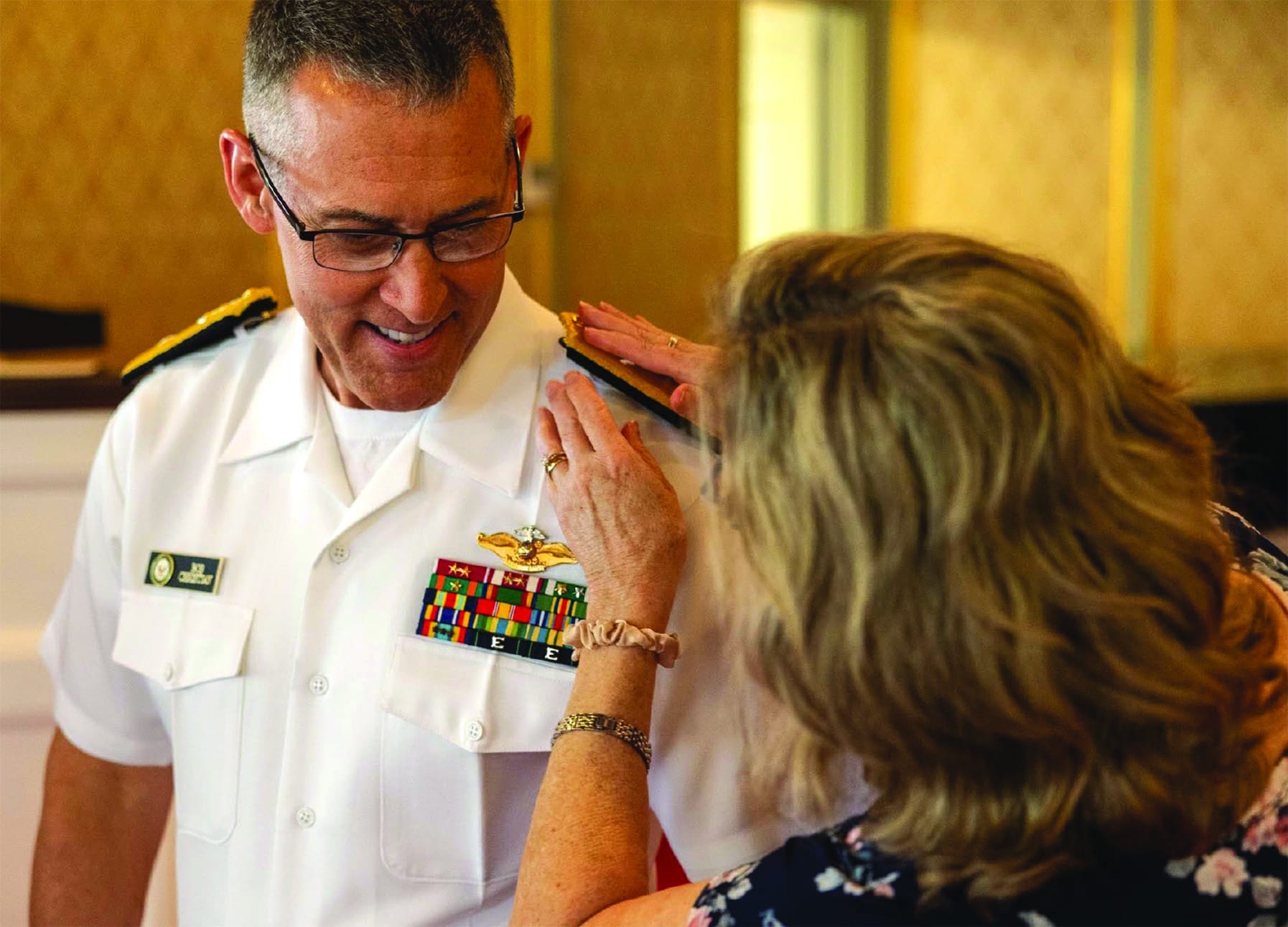
NEW ORLEANS (LBM) — U.S. Navy Chaplain Robert Christian, an alumnus of both New Orleans (M.Div., 1989) and Southwestern Baptist Theological Seminaries (D.Min., 1996), was recently promoted to rear admiral (lower half), a one-star flag rank.
His promotion was confirmed by President Donald J. Trump on May 18 and by the U.S. Senate on July 16, and his official celebration was held on July 17 at the Naval Support Activity, Hampton Roads, Virginia.
Rear-admiral (lower-half) is the second highest rank for Navy chaplains, and no active-duty Southern Baptist has held the rank since 1970.
In July Christian began serving in dual roles as the U.S. Navy deputy chief of chaplains (second highest ranking chaplain) and as the chaplain of the U.S. Marine Corps (highest ranking chaplain among U.S. Marines).
The Marine Corps is a separate military branch within the Department of the Navy, but it relies on the Navy for medical, religious, legal and operational support personnel. Navy chaplains also meet the religious needs of the U.S. Coast Guard, which operates under the Department of Homeland Security but may be transferred to the Department of the Navy during wartime.
Christian will be providing strategic leadership for more than 500 different chaplains and other personnel representing nearly 200 different religions or faith groups. In the Navy alone, these chaplains attend to the spiritual needs of more than 300,000 active-duty service members.
“It’s very humbling to receive this rank, and I am honored to serve such great chaplains,” Christian said. “I’ve always had an affinity for those in the military, and during my early years of ministry I discovered the military was the people group I was called to serve.”
Christian described the military as offering a unique opportunity for daily ministry.
“What’s different about military chaplaincy is that you are fully immersed in the world of service members,” he said. “It’s almost like incarnational ministry. You are on the same ships, you do the same field exercises, you’re eating and sleeping next to these same people. You experience their world, live life with them and talk about spiritual things with them. There is a lot of opportunity to talk about these things in these environments.”
Christian is a Louisiana native, having worshipped as a young man with First Baptist Church, Lafayette.
He also served as a minister with three Louisiana Baptist congregations (pastor, Liberty Hill Baptist Church, Jonesboro, 1984-1987; assistant to the pastor of evangelism, First Baptist
Church, New Orleans, 1987-1990; and pastor, Dutchtown Baptist Church, Prairieville, 1998-2000), and he shared that his role as pastor greatly helped him serve the men and women in the U.S. military.
Moreover, he emphasized that when he “sensed a call to vocational ministry, that call was coupled with a call to minister outside of the local church.”
Importantly, Christian said NOBTS was vital to his preparation to serve as a pastor and as a military chaplain.
“I enjoyed the deep theological conversations among my fellow students at NOBTS, whether it was on-campus or in the community,” Christian said. “That was really helpful to me as I sorted through some theological topics. My time at NOBTS taught me how to have a dialogue about faith with others.
He also said that NOBTS “excelled in emphasizing evangelism from multiple approaches,”
“It opened my mind to think outside the box in bringing the hope of the Gospel to whatever community you live in,” he explained.
Finally, Christian said NOBTS expanded his way of thinking “to find practical applications in a missional context as well.”
“These hours of instruction were helpful for my years of local church ministry, but they have also been helpful for the breadth of assignments I experienced within the military.”
Originally published by Baptist Press.