By Will Hall, Baptist Message executive editor
ALEXANDRIA, La. (LBM) – Just as Bible critics attack the Creation account in Genesis, they also take aim at the Flood account to claim God’s Word is not true.
However, just as science substantiates details in the Bible’s record of Creation, so science also adds credibility to the Flood description in Scripture.
There are three broad arguments that skeptics typically make to discredit the Bible’s report about the Flood events: (1) They claim there was no global flood. (2) They dismiss Scripture, by noting that there are other flood stories (a “guilt by association” tactic that ignores the differences between the Bible’s accurate record
and the fables and myths of other religions). (3) They reject biblical details as simply physically “impossible,” despite scientific discoveries which verify the biblical record.
“NO FLOOD”
Even secular scientists acknowledge that the Himalayans (the world’s tallest mountain range with the highest known mountain peaks on earth) are covered with fossil graveyards of marine animals. However, they argue that a slow collision of tectonic plates (“continental drift”) eventually raised an ancient seabed that stretched through what is now Nepal, India, China, Tibet and Nepal.
But the fossil record on all the 14 highest peaks shows a sudden event that trapped marine life. Sea animals were frozen in place while eating and mating, and there are no signs of bacterial activity which would have been part of the decay process if the fossils were gradually petrified.
The bottom line is that the geology argues for a catastrophic, rapid inundation and not a slow process of entombing marine life.
FLOOD “MYTH”
The specter of myth, fable and folklore is attached to Christianity’s truthful account because it is grouped with other religions’ stories about a great flood. It is likely these competing flood narratives have some basis in fact because they probably refer to the Flood described in Scripture. However, their differences with the Bible are significant.
For instance, Bible critics are quick to cite the “Epic of Gilgamesh,” which is filled with obvious fantasies, to discount the Bible as a myth.
In this Sumerian poem, Gilgamesh, king of the city of Uruk, is described as two-thirds divine and one-third human. He battles a man-beast named Enkidu and also encounters talking monsters and a scorpion man. A flood is caused by “angry, fighting gods,” but Gilgamesh is told how to build an “ark” (a cube, 192 feet on each side, built in seven days) so he and his family can survive a six-day flood.
There are so many points to address, but the but the biggest distinction between the “Epic of Gilgamesh” and Genesis 6-8 are the differences in the arks each describes.
Any mariner can attest to the instability of a box on turbulent waters, especially one 192 feet high, which would create a high center of gravity.
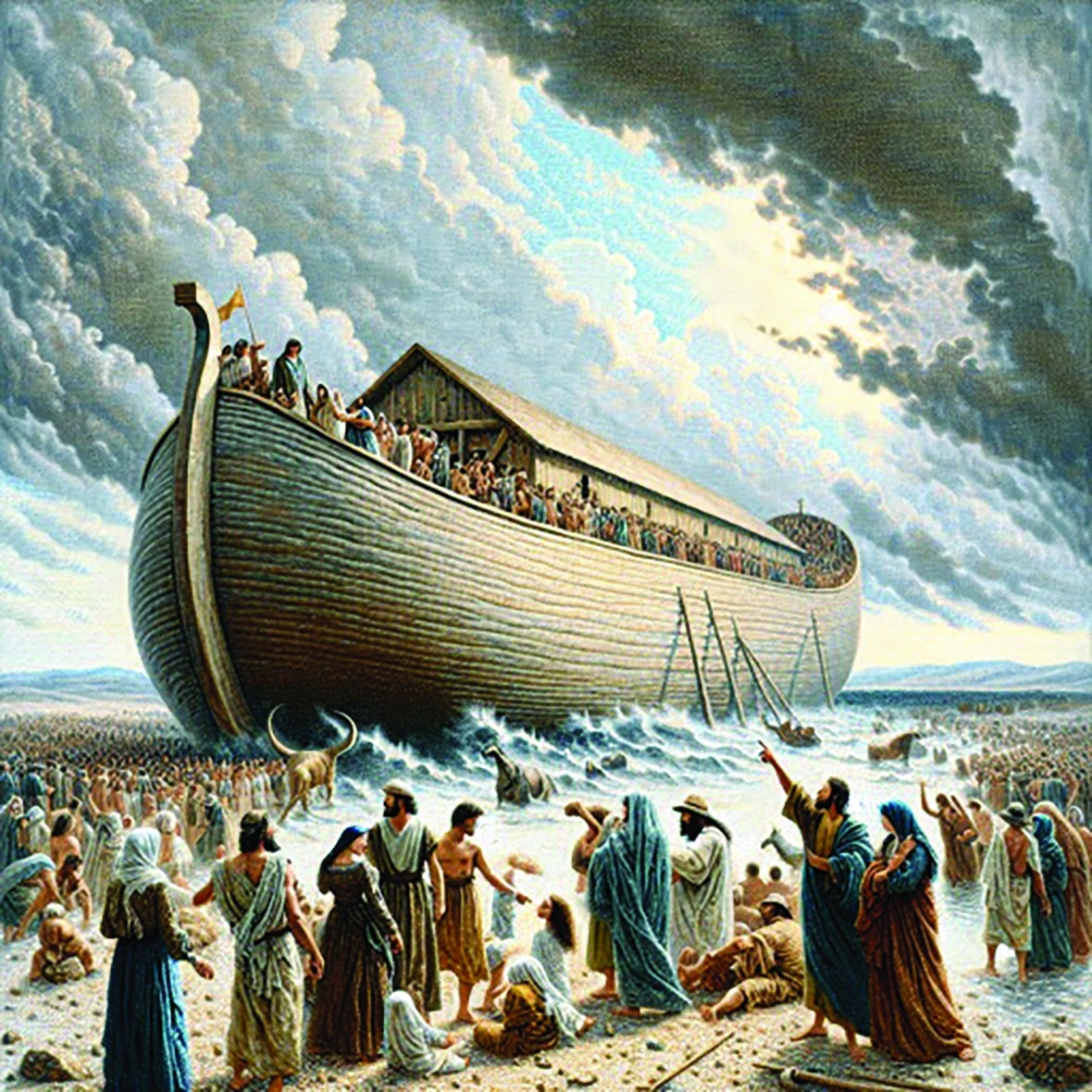
On the other hand, the dimensions of Noah’s ark with a 10:1 ratio of length to height as well as a broad width (also known as a beam) reflect the design of a stable sea-going structure. Indeed, research by Korean naval architects showed that the dimensions were ideal for stability in high waves (up to 100 feet tall).
Noah was not a marine architect, nor a material engineer, and there was no maritime ocean-going maritime industry during his lifetime. Yet, unlike Gilgamesh, he built a seaworthy vessel comparable to modern cargo ships.
FLOOD SOURCE?
Critics also decry the notion that “the windows of Heaven were opened. And the rain was on the earth forty days and forty nights” (Genesis 7:11b-12). They point to present day data to argue there is not enough water in the atmospheric system to cover the earth to the tops of the highest mountain peaks.
However, they appear to ignore Genesis 7:11a “the fountains of the great deep burst open,” and scientific discoveries that declare its truth.
In 2014, geologists found a rare diamond in Brazil containing a substance called ringwoodite, originating from the man stance called ringwoodite, originating from the mantle of the earth about 325 miles below the surface.
A careful analysis of the diamond, combined with extensive seismological experiments caused scientists to conclude that a “reservoir of water three times the volume of all the oceans [which cover 70 percent of the face of the earth] has been discovered deep beneath the earth’s surface. “It’s good evidence that the earth’s water came from within,” said Steven Jacobsen, a geophysicist from Northwestern University in Evanston, Illinois, and one of the lead researchers in the study.
GOD’S WORD IS TRUE
The Flood account, just like the Creation account, underscores two essential doctrines that one must believe in order to receive salvation (and each one supports the other): (1) You can place your full faith and trust in God’s Word; and (2) you can place your full faith and trust in His Son.
Indeed, “Faith comes by hearing, and hearing by the Word of God,” according to Paul (Romans 10:17).
This faith is confidence in what we hope for and assurance about what we do not see (Hebrews 11:1). But it is not blind faith. God also declared that “the invisible things of Him from the creation of the world” can be “understood by the things that are made,” thus people are without excuse if they disbelieve (Romans 1:20).
God’s Word is true, and, praise Him, His creation bears the evidence!